

Flood or water damage? Why the difference decides your claim
Storm, wind and waterWe Insure Downtown Miami
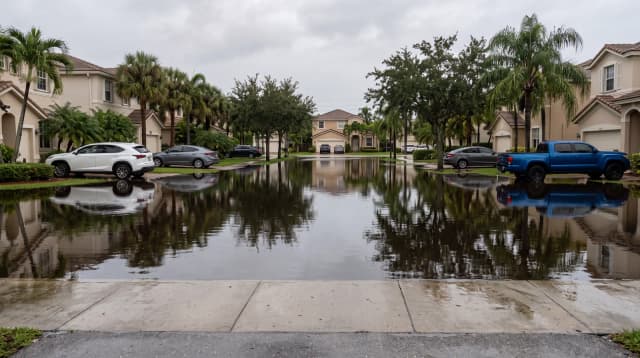
Water in your living room is not one thing to an insurance policy, it is two. If it came from a river, a storm surge or a street that filled up, that is a flood claim. If it came from a pipe inside your own wall, it is not — and the policy that answers is a different one, with a different deductible and a different adjuster. Most denied claims are decided by that distinction long before anyone inspects anything.
The definition does the work, and it is unusually specific
The NFIP does not leave "flood" to common sense. The official definition, as FEMA publishes it, is:
A general and temporary condition of partial or complete inundation of two or more acres of normally dry land area or of two or more properties (at least one of which is your property) from: overflow of inland or tidal waters; unusual and rapid accumulation or runoff of surface waters from any source; mudflow; or collapse or subsidence of land along the shore of a lake or similar body of water as a result of erosion or undermining caused by waves or currents of water exceeding anticipated cyclical levels.
Read the first clause again. Two or more acres, or two or more properties. A flood, for this policy, is an event with a footprint. It is not a description of how much water is in your house; it is a statement about how much land is underwater.
That single requirement decides most of the arguments people have with their carrier. Your kitchen can be under six inches of water and it can still fail the definition, because the definition was never about your kitchen.
So what is a burst pipe?
Not a flood. It fails the definition on its face: a pipe inside your wall does not inundate two acres or two properties, however much damage it does.
What it might be is a claim on your property policy, which is a separate contract covering different perils, with its own deductible and its own rules about sudden versus gradual damage. That is the conversation to have, and it starts on the other side of the boundary: home and condo insurance.
Your property policy
Water that starts inside the building: pipes, appliances, systems. Its own deductible, its own adjuster.
Your flood policy
Water that arrives from outside and covers land: overflow, surface runoff, storm surge, mudflow.
The line is not how much water there is, or how bad the damage is. It is where the water came from. Nobody decides this at claim time — the definitions decided it when the policies were written.
Rain is not a flood either, and that trips people up
The Standard Flood Insurance Policy excludes direct physical loss caused directly or indirectly by "rain, snow, sleet, hail, or water spray." Rain that comes through a roof is not a flood claim.
But it is not necessarily nobody's claim. Under Florida's definition of hurricane coverage, ensuing interior damage from rain is part of hurricane coverage when the direct force of the windstorm first damaged the building and made the opening the rain came through. Wind first, then water. Which is why the same wet ceiling can be a hurricane claim, a property claim or nothing at all, depending on a sequence of events nobody wrote down at the time.
What to do with that: photograph the sequence, not just the damage. Where the water entered, what the outside of the building looked like, and when. The adjuster is going to reconstruct an order of events, and the only evidence of order is what you captured while it was happening.
What flood insurance does not pay, even when it is a flood
This is the second surprise, and it is the one that hurts after the claim is accepted. From FEMA's own summary of coverage and from the policy form, the exclusions include:
- Additional living expenses. The policy does not pay for temporary housing while the building is repaired or unlivable — the form excludes "any additional living expenses incurred while the insured building is being repaired or is unable to be occupied for any reason." A property policy often has that coverage; a flood policy does not. If you are displaced, that gap is immediate and daily.
- Loss of use, loss of access, business interruption, and, in the policy's words, "any other economic loss you suffer."
- Your belongings, at depreciated value. Building coverage can settle at replacement cost under conditions the policy sets out, but claims for personal property "are always paid based on ACV" — actual cash value, which is replacement cost less depreciation. A ten-year-old sofa is paid as a ten-year-old sofa.
- Anything not inside a building. The policy does not cover personal property outside a building, nor "walks, walkways, decks, driveways, patios and other surfaces" outside the exterior walls, nor land, lawns, trees, shrubs, wells or septic systems. In practice, a large share of what a flood visibly ruins on a property is outside the walls.
- Cars. Self-propelled vehicles are excluded, with narrow exceptions. A flooded car is an auto insurance question: car insurance.
The Brickell version: below the lowest elevated floor
In an elevated building — which describes a great deal of what is built on the water here — the policy treats the space below the lowest elevated floor differently from the rest of the building. For items in an enclosure below that floor in an elevated post-FIRM building, or in a basement, the policy says coverage "is limited to" a specific list of items set out in the form.
That is not the same as "not covered," and it is not the same as covered. It is a short list, and what is in a ground-level enclosure usually is not on it.
For a unit owner in a tower, the question also runs the other way: much of what floods in a building is not yours at all. That boundary is its own subject: high-rise buildings and condominiums.
The two numbers, and the thirty days
Residential flood coverage through the NFIP is capped: up to $250,000 for the structure and up to $100,000 for contents, per fema.gov. Above those limits, coverage exists — but not from this policy.
And the policy has a 30-day waiting period before it takes effect, with a narrow exception when it is bought in connection with taking, increasing, extending or renewing a mortgage. There is no way to buy it as a storm approaches. FEMA also reports that over the ten years from 2014 to 2024, 29 percent of NFIP flood claims came from areas outside current high-risk flood areas — which is the argument for treating the waiting period as a calendar problem rather than a hurricane-season one.
The mechanics of buying it, the zones and the limits are set out on the flood insurance page. This post is about what happens afterwards.
What this post does not answer
This is an article about the boundary between two perils, written from the claim side. It is not a reading of your policy and it is not a coverage determination.
It cannot tell you whether a specific loss is covered — only your carrier's adjuster can, against your actual contract. It does not cover flood zones, elevation certificates or how flood premiums are set. And it does not replace the policy documents: the NFIP publishes the full form, and the exclusions section is the part worth reading before you need it.
Questions we get after water damage
The street flooded and it came into my garage. Is that a flood?
Very possibly — a street that fills and covers land beyond your property is what the definition describes. What is inside the garage is a separate question, and so is whether the garage counts as an enclosure below the lowest elevated floor.
My water heater burst while I was away. My flood policy will not pay?
No, and not because of a technicality. Water that originates inside the building is outside the definition of flood entirely. That claim belongs to your property policy, if it belongs anywhere.
It rained for three days and my roof leaked.
Rain is excluded from the flood policy. Whether it is covered elsewhere depends on why the roof let water in and whether a windstorm made the opening first.
Do I need flood insurance if I am not in a high-risk zone?
The zone sets whether a lender requires it, not whether water can reach you. FEMA's own claim numbers are the argument: a large share of NFIP claims come from outside high-risk areas.
I am on the 20th floor. Does any of this apply to me?
To your unit, less. To the building you own a share of — the garage, the lobby, the machinery, the elevators — quite a lot, and how that reaches you is a question about the association's policy and your own.
Where to start
If you own property here and have never checked whether you have flood coverage at all — separately from your property policy, because it is never included in it — that is the first thing to establish.
Get in touch with We Insure Downtown Miami, or start a coverage review and we will look at both policies together, which is the only way the gap between them becomes visible.