

What a Miami remodel can cost you in insurance
Your unit and your buildingWe Insure Downtown Miami
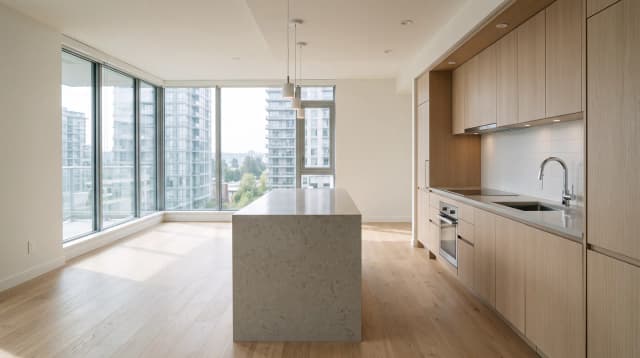
A remodel changes the property your policy describes, and a policy does not find out on its own. New kitchens, new floors, moved walls and upgraded systems are value you added after the last time anyone rated the building — so if a loss happens, the policy responds to the property it knows about, not the one you are standing in.
The gap between what you built and what your policy knows
Insurance is written against a description. Square footage, construction type, year built, systems, finishes, whether the roof was replaced and when. Every number in a quote traces back to that description.
A remodel edits the description. Sometimes lightly — paint and fixtures. Often substantially — a wall moved, a bathroom added, the electrical panel replaced, impact windows installed where there were none.
The description in the policy does not update itself. It updates when someone tells the carrier. Until then there are two properties: the one that exists, and the one that is insured. Most of the time nobody notices the difference. The moment it matters is the worst possible moment to discover it.
Four ways a remodel shows up later
1. Improvements the policy never priced
This is the plain one. If the reconstruction figure in your policy was set before the work, it reflects a property without the work. Rebuilding is not rebuilding what was there in the abstract — it is rebuilding to current condition and current construction costs.
Miami adds two pressures to that: construction costs here have not been stable, and buildings must be rebuilt to the code in force at the time, not the code that applied when they were built. A remodel that already brought part of the property up to current standards is worth telling your carrier about, precisely because it changes the number in the right direction as often as the wrong one.
2. Work done without a permit
Permitted work leaves a record. Unpermitted work leaves a kitchen.
The difficulty is not moral, it is evidentiary. When a carrier or an adjuster reviews a loss, permits and inspections are what establish that the work was done to code. Without them, the same work is an assertion. And unpermitted work does not stay a private matter: it surfaces when the property is sold, when the building is inspected, and when a claim is reviewed.
If a contractor suggests skipping a permit because it is faster, the honest translation is that the speed is being paid for later, by you.
3. The property changed use, and nobody said so
A remodel is often the moment a property starts doing something new. A unit that was a residence becomes a short-term rental. A ground floor becomes an office. A garage becomes a studio.
How a property is used is part of what a policy is written against — arguably a bigger part than the finishes. A property whose use changed is a property that should be re-quoted, and this is one of the few cases where re-quoting protects you rather than costing you.
4. Work in a building, where two policies meet
In a condominium the remodel happens inside a unit, but the building is shared. Removing a wall, moving plumbing, changing a floor covering above a neighbour — each of those touches the line between what the association's policy covers and what yours does.
That line is written in the building's documents, and it is not the same in every building. What is consistent is the shape of the problem: after a remodel, more of the property is on your side of the line than before.
The association's policy
The building as the association's documents define it — structure, shared systems, common areas.
Your unit policy
What is inside the unit, including improvements you made after the building was originally described.
Improvements you paid for tend to fall on your side of that line. Which means the more you remodel, the more your own policy is being asked to do — and the more it matters that it was told.
What to do, and when
The good news is that this is a scheduling problem, not an expensive one.
Before the work starts. Tell your carrier what is planned. Two things get decided here: whether the property is covered the way it needs to be while it is open — a property under construction is a different risk from a finished one — and whether your contractor's own insurance is real and current.
During the work. Keep the paper. Permits, invoices, before-and-after photos, the contractor's certificate of insurance. This costs nothing at the time and is the only version of events that exists later.
When it is finished. Send the summary to your carrier and ask for the property to be re-rated. This is the step almost everyone skips, and it is the one that closes the gap between the two properties.
If you live in a building. Check what the association required before the work and what it requires afterwards. Buildings differ, and the requirement is usually in writing.
What this post does not answer
This is an article about the relationship between a remodel and a policy. It is not a reading of your policy, and it is not construction or legal advice.
It cannot tell you whether your specific improvements are covered — that depends on your contract and, in a building, on the association's documents. It does not cover the permitting process itself, which is a matter for the local building department. And it does not price anything.
For what the underlying coverage does: home and condo insurance covers the unit or the house; high-rise buildings and condominiums covers the division between the association and the unit owner; and flood insurance covers a peril that a standard property policy does not, remodel or no remodel.
Questions we get about remodels
I only changed finishes. Does that matter?
Less than moving a wall, but it is still worth a note to your carrier, because finishes are part of what a rebuild has to reproduce. The rule of thumb is simple: if it would cost real money to do again, your policy should know it exists.
The work is already done and I never told anyone.
Then tell them now. A property that is described accurately today is in a better position than one whose description is wrong and stays wrong. The conversation after the fact is routine.
Does a remodel always raise what I pay?
Not always, and not only in one direction. Some work reduces risk — new roofing, new plumbing, new electrical, impact-rated openings — and carriers look at exactly those things. Other work adds value that has to be insured. Which effect dominates depends on what was done.
My contractor says he is insured. Is that enough?
Ask for the certificate and read who it names and what dates it covers. "I am insured" is a sentence; a certificate is a document. If something goes wrong on site, the difference between those two is the whole matter.
Does the association need to know?
Almost always, and usually before the work begins. Buildings set their own requirements for what can be modified inside a unit and what proof they want. Those requirements exist for the same reason your policy cares: the building is shared.
Where to start
If you have remodelled in the last few years and never updated your policy, the useful step is a review — the property as it is now, against the property your policy describes.
Get in touch with We Insure Downtown Miami with what was done and when, and bring the paperwork if you kept it.